Activism
/
November 26, 2025
Alice had the ability to look to the future and a world where laws and attitudes did not keep disabled people poor, pitied, and isolated.
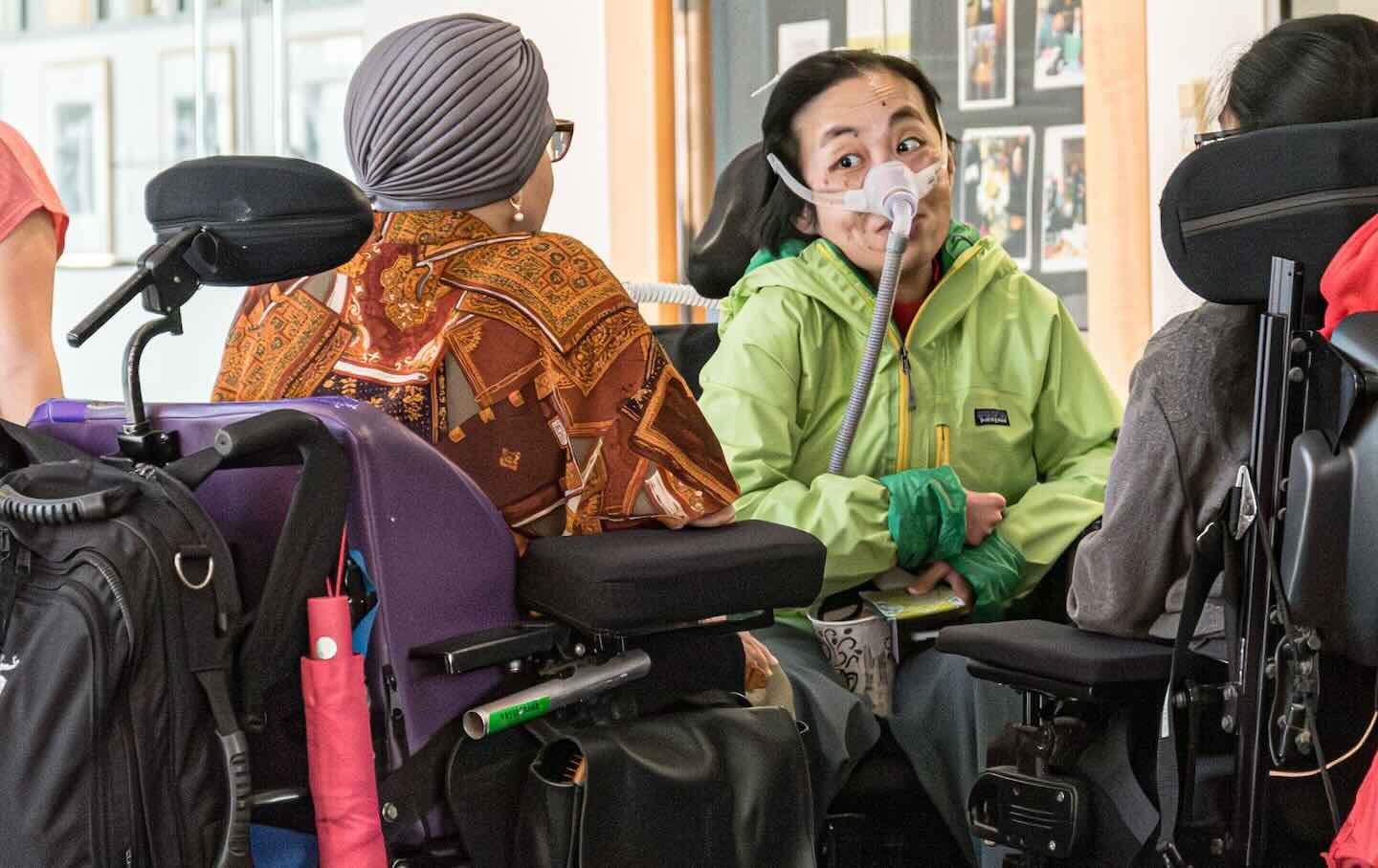
Disability rights activists Judy Heumann (1947–2023) (left) and Alice Wong (1974–2025) (center), along with another person, as they talk together at the opening of the San Francisco Main Library’s “Patient No More” exhibit on June 17, 2017.
(Anthony Tusler / Getty Images)
Imet Alice Wong in the spring of 2010. I was overseeing diversity and inclusion efforts for the Obama administration, and the White House was running a video contest for Asian American and Pacific Islander Heritage Month. People from all over the country were submitting videos to President Obama, sharing something they thought he needed to know about the Asian American experience. My colleague Gautam Raghavan oversaw it and received an overwhelming number of videos to watch, so he asked around to see if anyone was willing to volunteer to watch some. I gladly took a stack, and one afternoon, after pulling together slates of candidates for political appointments, I started working my way through them.
In my stack was a video from Alice Wong. She talked about the stigma of bringing in-home care workers into her family’s very traditional Chinese household in San Francisco. Living with muscular dystrophy, Alice explained how outside help made her feel uncomfortable at the same time that it made her more independent, and that more people like her needed access to high-quality home and community-based services instead of being pushed into nursing homes against their will.
She was about to turn 40, just a few years older than me, and the fact that she was fearing the possibility of institutionalization made me angry. The way she described the conundrum she faced was both informative and moving and made me mad that I sat in the White House and Alice had to fight just to live in her community.
I immediately picked up the phone and called her to tell her that the video she submitted blew my mind and to get her permission to pass it forward. I also asked her if she’d be interested in serving on the National Council on Disability, if we could figure out a way to make it work given her inability to travel.
That was the energy of Obama’s first term: If we could figure out how to do the hard things, we could do them. And so throughout the remaining Obama years, we found ways to redesign the table during Council meetings so it worked for Alice and other people for whom travel was a challenge, and thanks to Maria Town we ensured that Alice got to meet President Obama via iBOT at a commemoration of the Americans with Disabilities Act. I will never forget turning the corner and seeing our “robot overlord,” Alice Wong, wheeling around the East Wing.
Alice’s input on federal policy included everything from the need to strengthen existing policies like the Americans with Disabilities Act and the right to access home and community-based services, to accessible currency and the right to higher education.
Alice was constantly watching what people were doing, and lifting up people whose work she thought deserved attention and amplification. This was core to the creation of the Disability Visibility Project. Alice was the first person to ever recognize my work, as part of “Disability Visibility: People We Love.” Having that acknowledgement come from someone I respected and loved as much as Alice still means so much.
Current Issue

Alice loved science fiction. We nerded out over The X-Files, Fringe, and Orphan Black. She started using the word “Sestra” to describe the women in our circle of friends. We talked about the ways that disability either did or did not exist in those spaces. It was part of Alice’s ability to look to the future and a world where laws and attitudes did not keep disabled people poor, pitied, and isolated.
When Covid-19 hit, frankly none of us in our crowd were surprised. Alice wasn’t joking when she adopted the title of Oracle, as many in our friend group predicted bad things were on the horizon when we noticed the first major industry to face deregulation following the 2016 election was the nursing home industry, specifically its work on infection control standards. Her unapologetic attitude about masking and vaccines did not waiver and continued up to the day she passed. Her piece in Teen Vogue in January 2024, “Covid Isn’t Going Anywhere, Masking Up Could Save My Life,” served as a reminder that the pandemic was not over and that we all still needed to be masking. It was our duty to each other, regardless of federal, state, and local governments’ tendency to abdicate any authority.
But 2020 was a monumental year for the disability community, in terms of redefining our place in our democracy as the pandemic roared and political campaigns went virtual. CNN’s Jake Tapper discussed #CripTheVote, which had been founded in 2016 by Alice and fellow disability rights activists Andrew Pulrang and Gregg Beratran. #CripTheVote was an online movement, primarily on Twitter, focused on talking about the issues that mattered to disabled people and highlighting the ways the community was engaging in our democracy. Over the years, the founders organized debates and State of the Union watch parties and Twitter town halls for three presidential campaigns that allowed disabled people to directly engage with candidates. As a response to this organizing, the 2020 campaign season included debate questions for the first time that referenced the disability community and candidates went as far as to reframe non-disability questions in such a way that highlighted the impact on disabled people and their families.
When Alice was awarded a MacArthur fellowship in 2024, we were so excited, and at the same time, those of us who knew her understood how complicated this recognition of her work was. This award—which was beyond deserved for someone who had exemplified “exceptional creativity as demonstrated through a track record of significant achievement, and manifest promise for important future advances”—meant our friend could live a little longer in the community. It did not mean she could bask in the sun in Lake Como pitching George Clooney a movie about her life. It meant she could pay someone to receive the support necessary for basic functions like accessing nutrition, changing her clothes, and using the bathroom. I often wonder what her fellowship could have looked like if those basic needs were already met at the level and quality she needed.
Despite being a tremendous honor, the fellowship inspired a fresh wave of online attacks against Alice, particularly for her support of Gaza. But never once did she waiver. If anything, she did as she was prone to do and doubled down. Her work on “E-Sims for Gaza” with Jane Shi and Leah Lakshmi Piepzna-Samarasinha was so important in its effort to coordinate disabled people around the world in supporting people in Gaza who lost Internet access due to the war.
It was incredibly powerful to see the impact her life was having on people across the globe.
In many ways, Alice Wong was the first disabled public intellectual, and that “public” piece was not necessarily something the disability community was prepared for. As time went on, people who didn’t even know Alice assumed they knew best what she wanted, what mattered to her, and took it upon themselves to speak for her. Alice, who had fought for her right to bodily autonomy for so long, was having it attacked by the very people in her own community she was fighting for. When she died on November 14, she left a legacy that is up to all of us to carry forward.
Popular
“swipe left below to view more authors”Swipe →
While the administration flirts with the idea of a return to institutions, we need non-disabled people and allies to speak out to say that the cuts to Medicaid are not acceptable. There are not enough fellowships available to keep all disabled people out of nursing homes, and disabled people should not be expected to have to produce volumes of work to access care. Medicaid must be strengthened and reformed so that people who are dependent on these programs for their very survival, people like Alice and so many others, can have the support they need. That includes support for home and community-based services, so that disabled people have what they need economically to not just survive but thrive. GoFundMe cannot be an answer for the absurd cuts to Medicaid.
America’s systems, structures, and policies were not ready for Alice Wong. I dream of a world where her vision for disability rights isn’t “radical” but the norm.
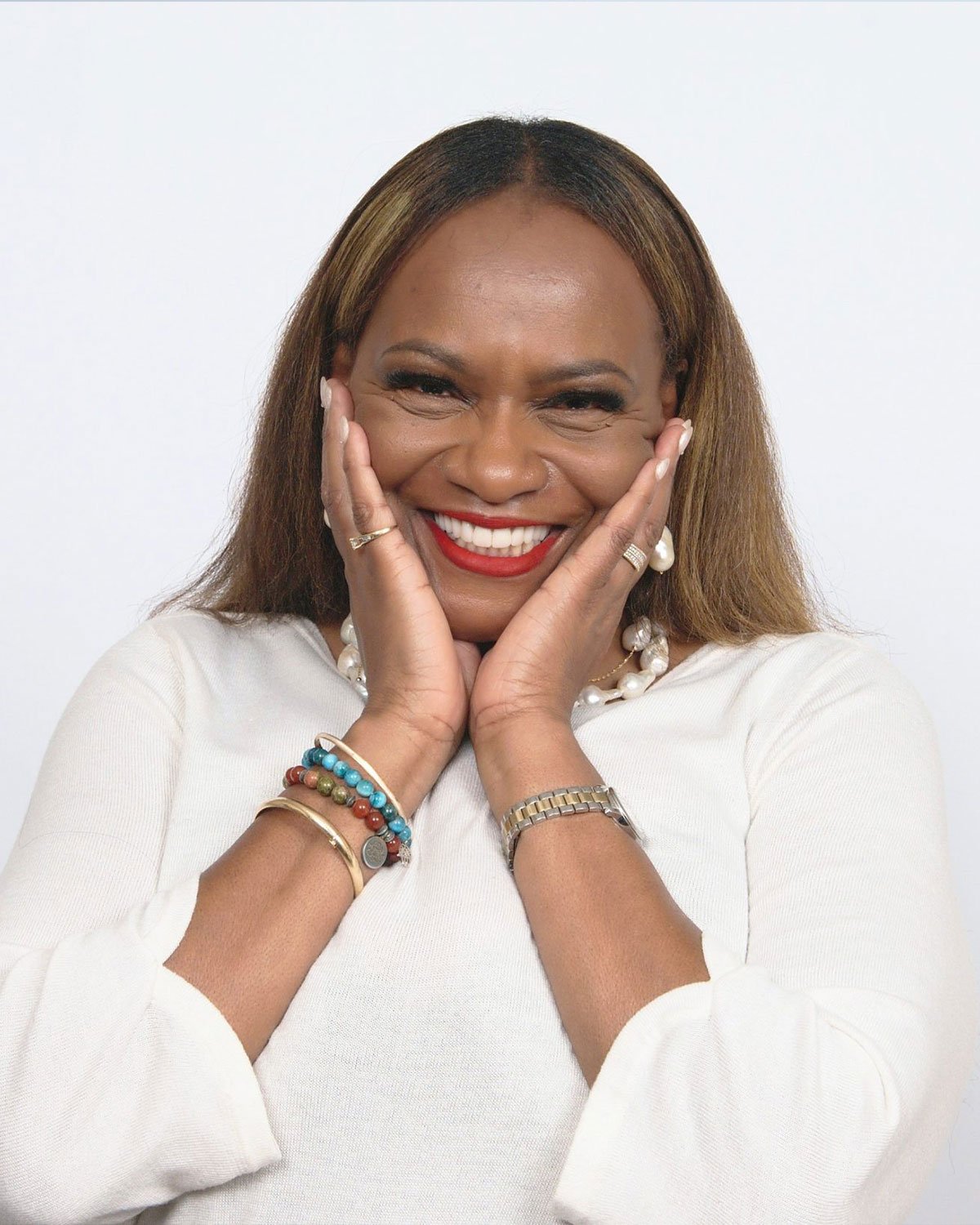
Felecia Phillips Ollie DD (h.c.) is the inspiring leader and founder of The Equality Network LLC (TEN). With a background in coaching, travel, and a career in news, Felecia brings a unique perspective to promoting diversity and inclusion. Holding a Bachelor’s Degree in English/Communications, she is passionate about creating a more inclusive future. From graduating from Mississippi Valley State University to leading initiatives like the Washington State Department of Ecology’s Equal Employment Opportunity Program, Felecia is dedicated to making a positive impact. Join her journey on our blog as she shares insights and leads the charge for equity through The Equality Network.


Hello Neat post Theres an issue together with your site in internet explorer would check this IE still is the marketplace chief and a large element of other folks will leave out your magnificent writing due to this problem
Attractive section of content I just stumbled upon your blog and in accession capital to assert that I get actually enjoyed account your blog posts Anyway I will be subscribing to your augment and even I achievement you access consistently fast
What i do not realize is in fact how you are no longer actually much more wellfavored than you might be right now Youre very intelligent You recognize thus considerably in relation to this topic made me in my view believe it from numerous numerous angles Its like men and women are not fascinated until it is one thing to do with Lady gaga Your own stuffs excellent All the time handle it up