Activism
/
StudentNation
/
February 4, 2026
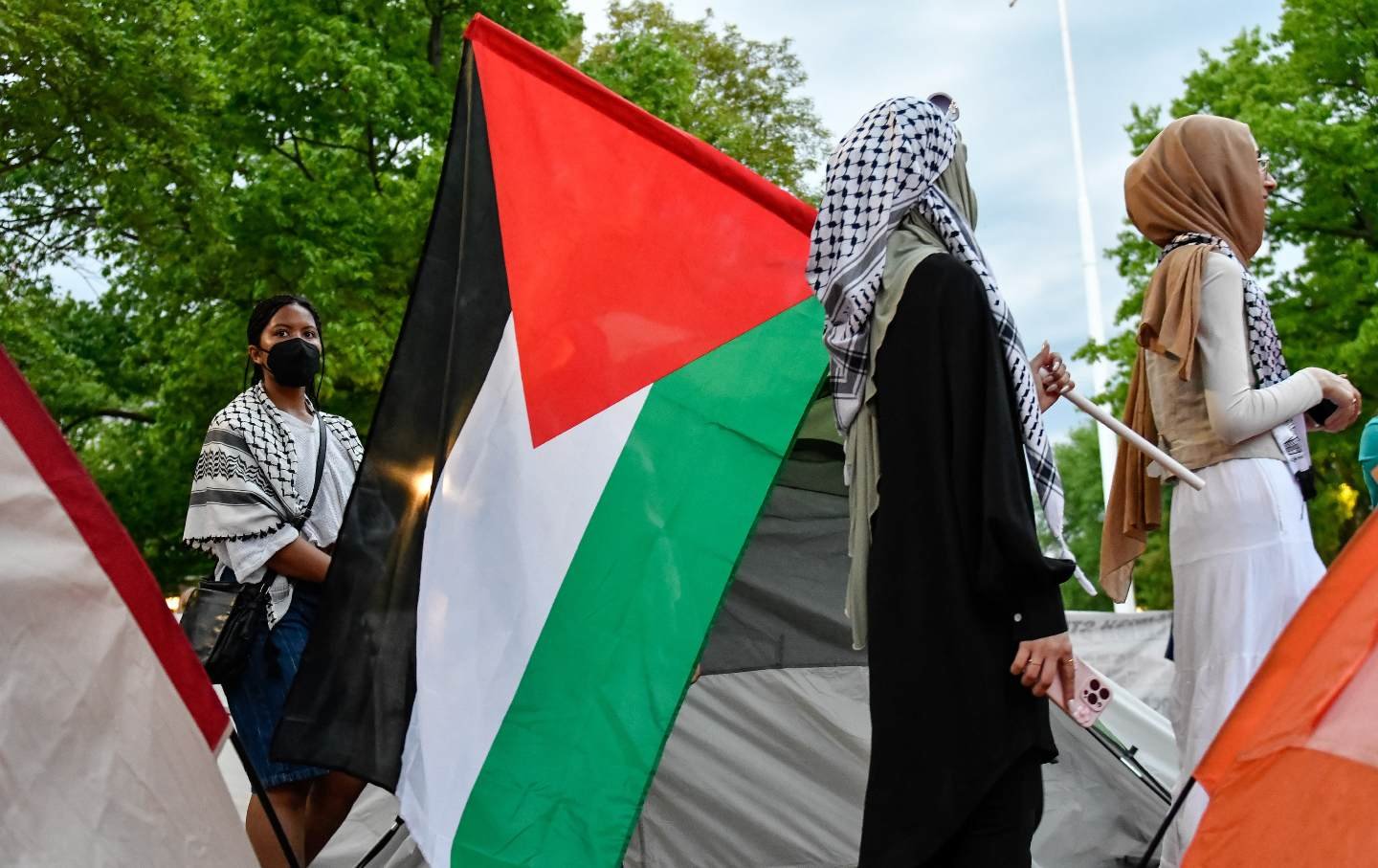
Universities across the country have used extraordinary measures to target student activists following more than two years of pro-Palestinian protests.
Pro-Palestinian protesters at the encampment on University of Michigan’s campus.
(Adam J. Dewey / Getty)
It took Josiah Walker nearly two months to realize he was being followed. One afternoon in July of 2024, as he was walking down State Street in Ann Arbor, a white car pulled up beside him. Walker, a student at the University of Michigan and member of the college’s pro-Palestine student activist group called Students Allied for Freedom and Equality (SAFE), recognized the car’s license plate, he said, having frequently noticed the vehicle around campus.
According to Walker, an older man got out of the vehicle and stood beside him for a moment, then began walking down the street in the same direction Walker had been going. Near the end of the block, though, the car’s driver stopped. As he did, Walker said he suddenly noticed multiple other vehicles—all of similar makes and models of the one now parked beside him—driving up and down the street.
Walker told The Nation he was becoming increasingly unnerved, and decided to go into a nearby academic building. He entered through one door and rushed through to another exit, hoping to put some distance between himself and the strange scene he had just witnessed on State Street. But just as he was about to leave, he spotted the same man through a window, standing just across the street outside. Hoping to avoid him, Walker said he retreated back into the building, going down its main stairwell towards a different, ground floor exit.
Upon reaching the new exit, Walker ran into a friend. And as the two engaged in small talk by the double doorway, Walkers said the man from the car on State Street walked right through it, pausing to stare directly at him. After a few seconds, the man turned around, left the building, and planted himself near the door.
Concerned that he was being paranoid, Walker walked out of the academic building he had been in, past the man, and around the corner. Then he waited to see if the man would follow him. He did. Walker turned and confronted him while filming the exchange on his own phone. “You guys do understand this is really weird, right?” he can be heard saying on the recording. “We know what we’re doing,” the man replied.
By that point, Walker said, his worst fears had already been confirmed: he was being surveilled on his own campus.
Current Issue
In June 2025, Walker’s allegations were made public by The Guardian alongside those of two other Michigan students who alleged to have been followed by private investigators hired by the university. In the wake of the outrage sparked by that article, the school quickly cut ties with investigative agency Detroit-based City Shield, who appeared to be responsible for the incident. But Walker says he still has yet to receive an official apology from the school, even though its actions created a “culture of fear and paranoia” which he calls “irreversible.”
Walker is not alone. Across the country, colleges have used extraordinary measures to surveil protesters following more than two years of pro-Palestinian protests. We spoke with four students from various institutions who shared similar experiences. Their stories demonstrate how student activism and free speech on campus has been under increasing attack.
The University of Michigan
Walker says that he first began suspecting that he was being watched in early summer 2024 after a police raid led to the dismantling of the University of Michigan’s Gaza Solidarity Encampment. “I think their goal was to scare me,” said Walker. “It was effective because I was like, what is going on?”
Responding to a request for comment, the University of Michigan directed The Nation to a public statement that was issued following The Guardian’s investigation. According to that statement, Michigan utilized “plainclothes security personnel” in order to help the college “keep watch over our campus and enable us to respond quickly to emergencies.” The college noted that “no individual or group should ever be targeted for their beliefs or affiliations.”
According to Brian Hauss, the deputy director of the American Civil Liberties Union’s speech, privacy, and technology project, the tactics colleges have used to surveil students are unprecedented. “While there have been other dark chapters in American history when the imperative to suppress dissent overcame our society’s commitment to academic freedom, the scale of repression we’re seeing now—led first and foremost by the Trump Administration and its cronies—is the worst it’s been in at least half a century.”
“Colleges and universities have a legal obligation to address invidious discrimination and targeted harassment,” Hauss said, “but they have no business censoring constitutionally protected expression just because people find it offensive or even bigoted.”
Walker recalled the anxiety of having to prepare himself before walking home from his job as a program specialist at Michigan’s Institute for Social Research, and the mental checklist he went through before leaving: “Make sure your phone is fully charged, make sure the camera lens is clean. Take a deep breath and prepare for anything to happen,” Walker said. “The main thing is [this] never-ending sense of you’re not safe on campus.”
Hauss said that the use of private investigators on college campuses can “chill constitutionally protected expression, undermine social trust essential to the academic community, and strike fear into the hearts of students. They are antithetical to everything the university should stand for.”
Bryn Mawr College
At Bryn Mawr College, students said they were called into confidential meetings by administrators throughout the summer of 2025. During those meetings, individuals who identified themselves as private investigators or lawyers questioned them about their peers’ political affiliation and reportedly asked them to identify student protesters in photographs.
Willa Hollinger was living off campus when she received an email from the dean of Bryn Mawr’s undergraduate college, Tomiko Jenkins, asking her to attend a “brief, confidential meeting regarding an important college matter.” The email lacked any specific information, and when Hollinger asked whether or not she was facing disciplinary actions, Jenkins responded by saying that she was “unable to share details in advance, as the matter is highly sensitive and part of a confidential process.”
When Hollinger arrived at the meeting, no Bryn Mawr representative was present. Instead, she was met with two individuals who identified themselves as outside lawyers hired by the school to investigate a protest that had occurred on campus a few months prior. Hollinger said that it was during this meeting that the investigators questioned her about the political affiliations of other students, and asked her to name students previously involved in pro-Palestinian activism on campus. They also presented her with photographs of students at protests and asked her to identify them.
“I was shocked at the blatant lack of ethics in how each part of the process was handled,” Hollinger said in a statement to The Nation.
“Any institution that has surveillance will naturally make their students want to look over their shoulders before saying what they want to say,” said Haley Gluhanich, a senior program counsel for campus rights advocacy at the Foundation for Individual Rights and Expression. “[Students] probably aren’t going to say what they actually want to say, which is just the complete opposite kind of culture and climate for free speech and institutions should be providing.”
Maya Mehta, a senior at Bryn Mawr, was previously a member of the college’s Students for Justice in Palestine chapter before the organization was placed on interim suspension in April of 2025. Throughout the past year, she said, students have been increasingly fearful of expressing themselves politically on campus. “We went to school to not only be educated and get a degree, but also to expose ourselves to the world and learn how to care about things and how to take action about things that we care about,” said Mehta.
Responding to a request for comment regarding the allegations of private investigators on campus, Samara Sit, Bryn Mawr’s vice president for communications and marketing, stated that “the College is responsible for protecting all students, faculty, and staff on campus. When acts of vandalism and property damage take place, and it is not clear who is responsible, we have an obligation to investigate, which is what we did.”
But the lingering effects of these policies have impacted the entire campus, said Mehta, even affecting students who have yet to experience them directly. “If you haven’t been the subject of some sort of investigation [or] some sort of surveillance, [then] you know someone who has been, or you know someone who knows someone,” she said.
Swarthmore College
At Swarthmore College, two student activists said that they have been on guard following a semester of increased surveillance, including the installation of new security cameras and a series of college-led investigations which, as reported by The Phoenix, Swarthmore’s student newspaper, longtime faculty members believe departed from the college’s traditional values and practices.
In a comment to The Nation, Swarthmore’s vice president of communications and marketing Andy Hirsch rejected the claim that the college procedures had deviated from previous investigations, and said that the newly installed cameras were a result of regular updates to the college’s security system.
“We’ve used CCTV cameras for more than 20 years to enhance campus safety and security,” Hirsch said. “We do regularly assess the number of cameras and add additional cameras based on various factors, such as when we bring new buildings online.”
Despite this, one student, who requested to remain anonymous due to fear of administrative retribution, told The Nation that they “don’t feel very comfortable talking about politics on campus.”
“There’s a level of constant paranoia,” they said.
Popular
“swipe left below to view more authors”Swipe →
Sam, a pseudonym for another Swarthmore student who also asked to remain anonymous due to fear of administrative reprisal, said that he became involved with campus activism as a freshman in 2024, specifically attending pro-Palestinian protests and rallies. But in September of 2025, following a semester of rising tensions and the administration’s decision to dismantle an unsanctioned four-day encampment, Swarthmore permanently revoked affiliation with the campus chapter of SJP.
Since the chapter’s official dissolution, Sam said that even simple acts—such as putting up flyers in support of Palestine—can result in disciplinary action, since all posters need to be signed by a recognized college organization. “Something designed as a place of learning should also have pretty open discourse,” said Sam.
Sam told The Nation that he believed security cameras had been used to identify students like him, who had posted flyers in violation of the college’s posting policy. “I will say they have sent me messages about flyering that I’ve done that they wouldn’t know that I put up specifically, unless they’re looking at the cameras.”
When asked about students facing disciplinary action after posting flyers in campus spaces, Hirsch said that it was not a result of the “content,” but violations of Swarthmore’s student code of conduct. Hirsch, however, did confirm to the Nation that security cameras may have previously “played a role in identifying the individuals” who posted them.”
“The College deeply values and supports individuals’ rights to express their views and engage in peaceful protest and dissent,” Hirsch said in an e-mailed statement to The Nation. “The College’s policies are designed to ensure that individuals can do so without infringing on the ability of other students, faculty, and staff to live, learn, work, and fully engage in campus life.”
Hauss notes that colleges and universities do have a legal obligation to address discrimination or targeted harassment, but notes that there is no obligation to “[censor] constitutionally protected expression just because people find it offensive or even bigoted.”
“Public debate only works when people are free to make up their own minds,” Hauss told The Nation. “In academia, a victory achieved through force, rather than reason, is no victory at all.”
From Minneapolis to Venezuela, from Gaza to Washington, DC, this is a time of staggering chaos, cruelty, and violence.
Unlike other publications that parrot the views of authoritarians, billionaires, and corporations, The Nation publishes stories that hold the powerful to account and center the communities too often denied a voice in the national media—stories like the one you’ve just read.
Each day, our journalism cuts through lies and distortions, contextualizes the developments reshaping politics around the globe, and advances progressive ideas that oxygenate our movements and instigate change in the halls of power.
This independent journalism is only possible with the support of our readers. If you want to see more urgent coverage like this, please donate to The Nation today.
More from The Nation
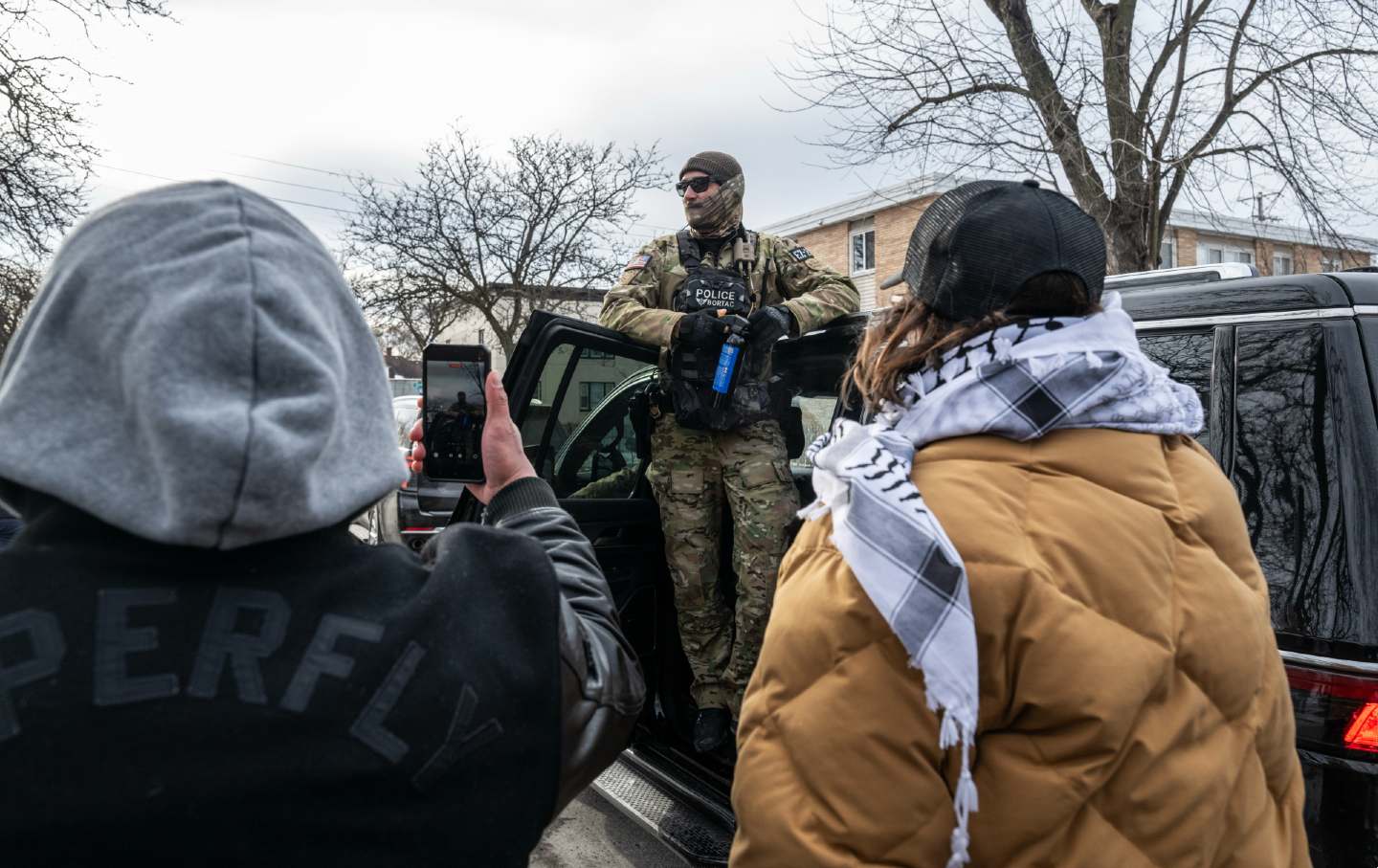
Without their videos of ICE shootings, we wouldn’t know what is really happening.
Mark Hertsgaard
Minneapolis right now reminds me of what I’ve seen during my time in the West Bank.
Ariel Gold
The brave protesters in Minneapolis are doing everything that Democrats and even the law have failed to do.
Elie Mystal
With their resistance to violent authoritarianism, the people of Minneapolis have renewed the spirit of Dr. King’s call for “the positive affirmation of peace.”
The Editors
I want you to know why I chose to keep fighting for the world you deserve.
Adrianne Wright
Felecia Phillips Ollie DD (h.c.) is the inspiring leader and founder of The Equality Network LLC (TEN). With a background in coaching, travel, and a career in news, Felecia brings a unique perspective to promoting diversity and inclusion. Holding a Bachelor’s Degree in English/Communications, she is passionate about creating a more inclusive future. From graduating from Mississippi Valley State University to leading initiatives like the Washington State Department of Ecology’s Equal Employment Opportunity Program, Felecia is dedicated to making a positive impact. Join her journey on our blog as she shares insights and leads the charge for equity through The Equality Network.


